Guide
Cold Weather Rule 2026–27: When Your Heat Can’t Be Shut Off, by State
Seven states’ winter shutoff protections side by side, each read on the state’s own official page: the dates, who qualifies, what you have to do and the number to call.

CheckedOct. 312026
The short answer
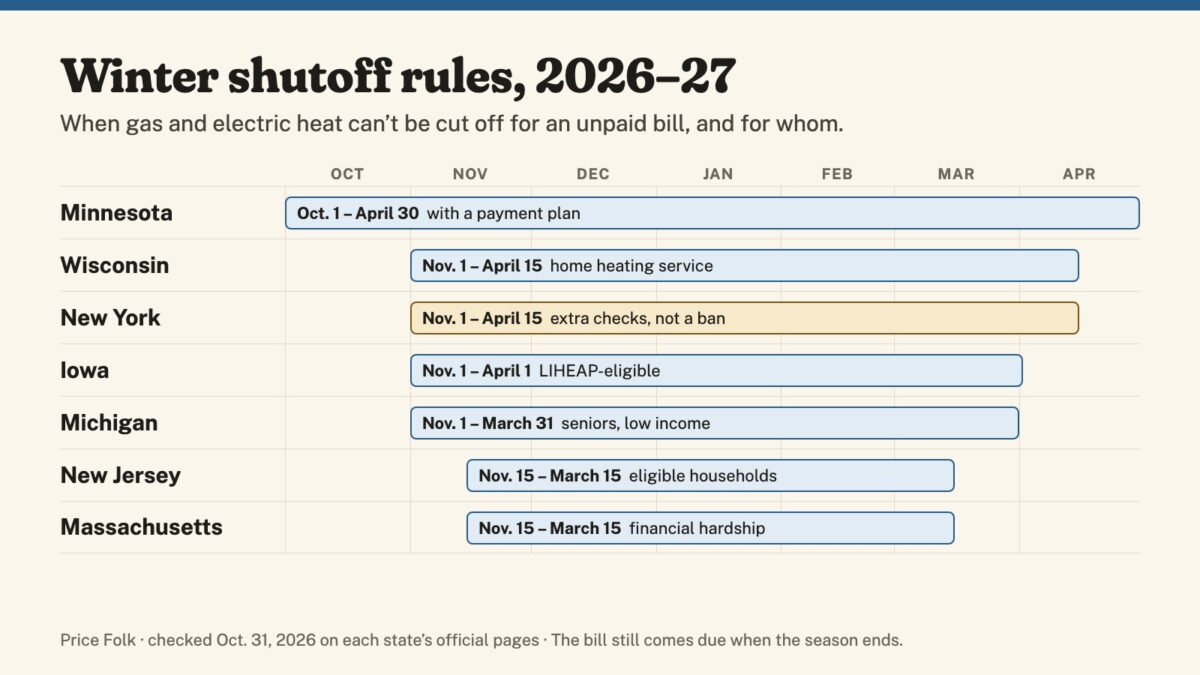
In many cold-weather states, yes, but not without limits. Winter rules stop or slow shutoffs of gas and electric heat only during set dates, and usually only if you qualify or set up a payment plan.
- Minnesota: Oct. 1 to April 30, for customers who make and keep a payment plan
- Wisconsin: Nov. 1 to April 15, no shutoffs of home heating service for nonpayment
- Michigan: Nov. 1 to March 31, for seniors and low-income customers
- Iowa: Nov. 1 to April 1, for LIHEAP-eligible households
- New Jersey and Massachusetts: Nov. 15 to March 15 (New Jersey’s program and Massachusetts’ hardship rule)
- New York: no winter ban, but extra checks Nov. 1 to April 15
In every case, the bill still comes due.
At a glance
- Earliest start
- Minnesota, Oct. 1
- Most states
- Nov. 1 or Nov. 15, through mid-March or mid-April
- Latest end
- Minnesota, April 30, 2027
- Who is covered
- Depends on the state: all home heating customers in Wisconsin; seniors and low-income customers in Michigan; LIHEAP-eligible households in Iowa
- Do you still owe?
- Yes. The protection pauses shutoffs; it does not cancel the bill
- Not in the table yet
- Missouri, Kansas, Illinois and Pennsylvania (their state pages did not load on Oct. 31)
- Last checked
- Saturday, Oct. 31, 2026, against the sources at the end of this page
Winter shutoff rules, state by state
| State | 2026–27 dates | Who is protected | What you have to do | Official page |
|---|---|---|---|---|
| Minnesota (Cold Weather Rule) | Oct. 1 to April 30 | Residential electric and natural gas customers, renters included, when gas or electricity is the main heat and the account is in their name. Every gas and electric utility must offer it. | Set up and keep a Cold Weather Rule payment plan. The utility must offer one that is reasonable for your household’s finances, any time during the season. | Minnesota PUC |
| Wisconsin (winter moratorium) | Nov. 1 to April 15 | Residential customers: utilities may not disconnect service for nonpayment when it is used for home heating. | It applies under state law. If you are already disconnected, the utility does not have to reconnect you until you make payment arrangements. | Wisconsin PSC |
| New York (cold weather period) | Nov. 1 to April 15 | Residential gas, electric and steam customers with heat-related service. | Nothing to sign up for, and it is not a ban: before shutting off heat-related service, the utility must try to reach you at least three days ahead and again that day, and alert local social services if the shutoff could harm someone in the home. | New York DPS |
| Iowa (winter moratorium) | Nov. 1 to April 1 | Households certified eligible for LIHEAP or its weatherization program; covers electric and natural gas heating service. | Apply for LIHEAP through your community action agency (applications run Nov. 1 to April 30, 2027). Telling your utility you are applying gets you a 30-day stay of disconnection. | Iowa Utilities Commission |
| Michigan (Winter Protection Plan) | Nov. 1 to March 31 | Customers of state-regulated gas and electric companies who are 65 or older, receive state cash or food assistance or Medicaid, or have household income at or below 150% of the federal poverty level. | Ask your utility to enroll you. Low-income customers pay 7% of their estimated annual bill each month; seniors have no set monthly payment. What is owed is paid off in installments from April through November. | Michigan PSC |
| New Jersey (Winter Termination Program) | Nov. 15 to March 15 | Electric, gas, water and wastewater customers who get Lifeline, HEAP, TANF, SSI, PAAD, General Assistance or USF, some water-assistance applicants, and anyone who can’t pay because of circumstances beyond their control, such as unemployment, illness or medical bills. | Call your utility and ask for Winter Termination Program protection. Customers in the last group can self-certify that they can’t pay. | New Jersey BPU |
| Massachusetts (winter moratorium) | Nov. 15 to March 15 | Gas and electric service used for heating, when the unpaid bill is due to financial hardship (state law, M.G.L. c. 164, § 124F). | Contact your utility about financial hardship protection before a shutoff. | Mass.gov |
These are the protections each state’s own pages describe for residential customers.
Your utility may offer more. And a few details, such as which utilities a state regulates, differ from state to state.
What none of these rules do
- Erase the bill. Michigan’s plan has you pay off what you owe in installments from April through November.
Iowa’s regulator tells protected households to keep paying toward their bills, to avoid a large debt when the moratorium ends.
Minnesota’s rule protects you only while you keep up your payment plan. - Cover every fuel. Minnesota’s rule doesn’t apply to heating oil, propane or wood, though propane dealers there must offer a budget billing plan.
If your oil or propane furnace runs on electricity, ask the electric company for Cold Weather Rule protection. - Turn the heat back on by themselves. In Wisconsin, a utility doesn’t have to reconnect a customer who is already shut off until payment arrangements are made.
In Minnesota, once you make and keep a payment plan, the utility turns the heat back on. - Last past the season. Each protection ends on its date.
In Minnesota, a customer who stops paying on a Cold Weather Rule plan can be shut off, and the utility doesn’t have to offer another plan until the next season.
If you got a shutoff notice
- Call the utility before the date on the notice and ask for your state’s winter protection by name: a Cold Weather Rule payment plan in Minnesota, the Winter Protection Plan in Michigan, the Winter Termination Program in New Jersey.
- Apply for energy assistance.
In Iowa, telling your utility you’re applying for LIHEAP gets you a 30-day stay of disconnection.
In Wisconsin, help runs through the Wisconsin Home Energy Assistance Program (1-866-432-8947).
In Massachusetts, an Oct. 5, 2026, executive order declared an energy emergency and expanded home heating assistance to families earning 60% to 100% of the state median income. - If you can’t agree on a payment plan, go to the state. In Minnesota, you can appeal to the Public Utilities Commission within 10 days on the utility’s form, and your service stays on during the appeal.
- Medical emergency at home? In New York, a certificate from a doctor or the local Board of Health keeps service on for 30 days, and it can be renewed.
If you and every adult in the home are 62 or older, blind or disabled, the utility must make extra efforts to reach you, and keep service on another 15 business days if no arrangement is made.
State numbers to call
- Minnesota Public Utilities Commission, Consumer Affairs: 651-296-0406 or 1-800-657-3782
- Wisconsin Public Service Commission: 608-266-2001 or 1-800-225-7729
- New York Department of Public Service helpline: 1-800-342-3377, 8:30 a.m. to 4 p.m. on business days
- Iowa, to find your community action agency for LIHEAP: 515-776-8871
- Michigan Public Service Commission: 1-800-292-9555
- New Jersey Board of Public Utilities: 800-624-0241
Watch
 1:28
What we don't know yet
- Missouri and Kansas: people search for their Cold Weather Rules more than any others, but neither state utility commission’s website loaded when we checked on Oct. 31, so we have not listed their terms. We will add them once we can read them on the state’s own page.
- Illinois and Pennsylvania: their utility commissions’ pages on winter shutoffs did not load when we checked on Oct. 31, so they are not in the table yet.
- Other states, and municipal utilities and electric co-ops outside Minnesota: rules differ, so check with your utility and your state’s utility commission.
When any of this is confirmed, it goes into the page and the update history below.
Questions people ask
What is the Cold Weather Rule?
In Minnesota, it is a state law that protects residential electric and natural gas customers from having service shut off from Oct. 1 to April 30, as long as they set up and keep a payment plan with their utility. Other states protect customers in winter under other names, such as Michigan’s Winter Protection Plan, New Jersey’s Winter Termination Program and the winter moratoriums in Wisconsin and Iowa.
When does the Cold Weather Rule start in Minnesota?
Oct. 1, and it runs through April 30. You can set up a Cold Weather Rule payment plan with your gas or electric utility at any time during that season.
Can the utility shut off my heat in winter in Wisconsin?
Not for nonpayment between Nov. 1 and April 15 when the service is used for home heating. If you are already disconnected, the utility does not have to reconnect you until you make payment arrangements.
Who qualifies for Michigan’s Winter Protection Plan?
Customers of state-regulated gas and electric companies who are 65 or older, receive state cash or food assistance or Medicaid, or have household income at or below 150% of the federal poverty level. It runs Nov. 1 to March 31; ask your utility to enroll you.
Can my gas be shut off in winter in New York?
Yes, but from Nov. 1 to April 15 the utility must first try to reach you at least three days before and again on the day of the shutoff, and notify local social services if cutting heat-related service could harm someone in the home.
Do I still have to pay my utility bill during the winter moratorium?
Yes. Winter rules pause shutoffs; they do not cancel what you owe. Michigan’s plan, for example, has customers pay off the balance in installments from April through November.
Does the Cold Weather Rule cover propane or heating oil?
Not in Minnesota: the rule does not apply to delivered fuels such as fuel oil, propane and wood, though propane dealers must offer a budget billing plan. If your furnace runs on electricity, you can ask the electric company for protection.