Guide
Storm Damage Insurance Claim: What to Do After Hail or a Tornado, and Your Insurer’s Deadlines in NJ, PA, DE and MD
Hail up to golf-ball size and a confirmed tornado hit four states on Nov. 12. The first steps state regulators give, the wind/hail deductible to check, the deadlines each state puts on your insurer, and how to check a roofer before you sign.

CheckedNov. 122026

The short answer
If hail, wind or a tornado damaged your roof, siding or windows, take photos, cover the openings and call your insurer. Tarps and boards are usually covered, so keep the receipts; permanent repairs wait for the adjuster.
Then the clock is on the insurer. It must acknowledge your claim within 10 working days in New Jersey and Pennsylvania and 15 in Delaware and Maryland. After you send a signed proof of loss, New Jersey sets 30 days to pay, Pennsylvania and Maryland 15 working days to accept or deny, and Delaware 30 days.
Check your policy for a separate wind/hail deductible, often a percentage of the home’s value, and check any roofer’s state registration or license before you sign.
General information, not insurance or legal advice. Your policy, your plan and your state’s rules decide what is covered.
At a glance
- Nov. 12 storms
- Confirmed tornado near Christiana Hospital, Del.; hail up to 1.75 inches in N.J. (NOAA preliminary reports)
- First
- Photos before cleanup; tarp and board up; keep receipts
- Insurer must acknowledge
- 10 working days in N.J. and Pa.; 15 in Del. and Md.
- Decision after proof of loss
- N.J. 30 days to pay; Pa. and Md. 15 working days; Del. 30 days
- Deductible
- Look for a separate wind/hail deductible, often a % of the home’s insured value
- Before you sign
- Check the roofer: N.J. registration, Pa. HIC number, Md. MHIC license, Del. business license
- Last checked
- Thursday, Nov. 12, 2026, against the sources at the end of this page
What hit on Nov. 12
The Storm Prediction Center’s preliminary list for Nov. 12, 2026 has 34 hail reports, 7 wind damage reports and 1 tornado, all in New Jersey, Pennsylvania, Delaware and Maryland.
The tornado touched down near Christiana Hospital in New Castle County, Del. The report from the National Weather Service office in Mount Holly, N.J., says radar and video confirm it. Reports from nearby Woodshade mention trees and wires down and minor house damage.
In Chesterfield Township, N.J., the fire department reported a barn and a garage collapsed in what the report calls a probable tornado.
The biggest hail was golf-ball size (1.75 inches), near Lakehurst and Burlington Township, N.J.
| County | Largest hail reported | Hail reports |
|---|---|---|
| Burlington, N.J. | 1.75 in. (golf ball) | 10 |
| Ocean, N.J. | 1.75 in. (golf ball) | 4 |
| New Castle, Del. | 1.5 in. | 5 |
| Salem, N.J. | 1.5 in. | 1 |
| Bucks, Pa. | 1.5 in. | 1 |
| Montgomery, Pa. | 1 in. (quarter) | 3 |
| Monmouth, N.J. | 1 in. (quarter) | 2 |
| Lancaster, Pa. | 1 in. (quarter) | 2 |
| Cecil, Md. | 1 in. (quarter) | 2 |
| Camden, Gloucester (N.J.); Delaware, Philadelphia (Pa.) | 1 in. (quarter) | 1 each |
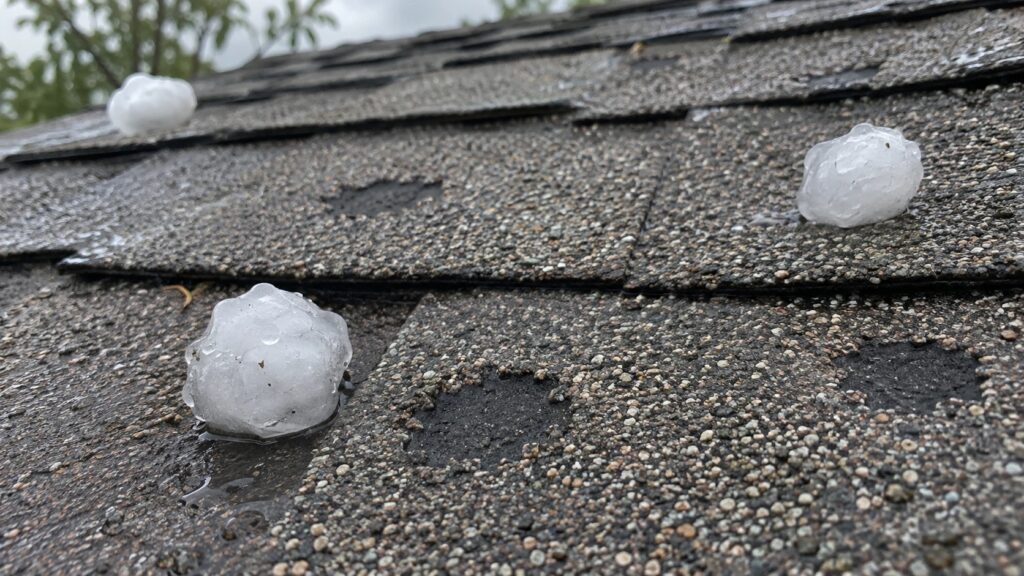
If you’re in one of these counties, the regulators’ advice is to inspect the structure and the roof after every storm, even if nothing is leaking yet.
The first 48 hours
These steps come from the insurance regulators of New Jersey, Pennsylvania and New Mexico, whose storm checklist the regulators’ national association publishes.
- Photograph and video everything before you clean up or fix anything: the roof, siding, windows and gutters.
- Stop more damage. Tarp the roof, board up broken windows. The New Jersey Department of Banking and Insurance says those temporary repairs are usually covered by your policy. Keep every receipt.
- Hold off on permanent repairs until the adjuster has seen the damage.
- Call your insurer or agent. Have your policy number ready and ask what documents and forms they want.
- Keep a log of everyone you talk to: the date, the name and the title.
- If you can’t stay in the house, keep the receipts for hotels and meals. Additional living expenses are a separate part of the claim.
Water that got inside starts a different clock: the EPA says to dry wet areas within 24 to 48 hours to keep mold from growing. Our burst pipe guide has the details.
Is it covered, and what’s your deductible?
Damage from wind, hail and tornadoes is a homeowners insurance claim, unless your policy leaves wind and hail out: depending on where you live, some do, and wind and hail then come as a separate policy. Flood is the other exception: a standard homeowners policy doesn’t cover it, and flood insurance is a separate policy that usually takes 30 days to start (more in our El Niño winter guide).
Before you file, find the declarations page and look for a wind/hail or windstorm deductible. The NAIC says it applies to any wind or hail damage, such as a tree that falls on your roof on a windy day. It’s often a percentage of the home’s insured value, not a flat amount.
The math matters. On a home insured for $300,000, a 2% wind/hail deductible is $6,000 out of your pocket before the insurer pays anything. A few cracked shingles may cost less than that to fix.
Policies can also deny damage caused by neglect, such as a dead limb you knew was hanging over the roof, the Pennsylvania Insurance Department warns.
The clock on your insurer, state by state
Once you report the claim, each state’s rules give your insurer deadlines. They’re in each state’s insurance regulations, and here they are side by side.
| State | Acknowledge your claim | Investigation | Decision after your proof of loss | If it needs more time | The rule |
|---|---|---|---|---|---|
| New Jersey | 10 working days | Must start within 10 working days | 30 days to pay, unless there’s a clear justification | A letter with the reasons by day 30, then every 45 days. An amount you’ve agreed on is paid within 10 working days | N.J.A.C. 11:2-17.6 and 17.7 |
| Pennsylvania | 10 working days, with the claim forms you need | Should be finished within 30 days of your notice, unless it reasonably can’t be | 15 working days to accept or deny | A letter with the reasons within 15 working days, then at 30 days and every 45 days | 31 Pa. Code 146.5 to 146.7 |
| Delaware | 15 working days | Must start within 10 working days | 30 days to affirm or deny | The reason in writing within those 30 days | 18 Del. Admin. Code 902 |
| Maryland | 15 working days | No set deadline; see the next column | 15 working days to affirm or deny, unless the investigation is still open or your policy sets a time limit | A letter with the reason at 45 days, then every 45 days | COMAR 31.15.07.03 and .04 |
The decision clock starts with your proof of loss, the signed statement of what was damaged and what you’re claiming. Ask the adjuster for the form, send it back as soon as it’s complete, and keep a copy with the date you sent it.
One more Pennsylvania rule: if you’re still negotiating without a lawyer, your insurer must warn you in writing 30 days before a deadline in your policy or the law runs out on your claim.
A missed deadline is worth reporting to your state’s insurance department, though it doesn’t by itself decide your claim.
Checking the roofer before you sign

“Natural disasters can be a magnet for dishonest solicitors,” the Pennsylvania Insurance Department says. Be wary of anyone who knocks on your door after a storm, contractors and public adjusters included.
| State | What the contractor needs | How to check | Also worth knowing |
|---|---|---|---|
| New Jersey | Home improvement contractor registration with the Division of Consumer Affairs, which requires $500,000 of liability insurance | Ask for the registration number. State law requires it on the company’s vehicles, ads, website and contracts. Check it with the Division at 800-242-5846 | After Superstorm Sandy, Division investigators checked 628 contractors working on damaged homes; 124 weren’t registered |
| Pennsylvania | Registration with the Attorney General if the contractor does more than $5,000 of home improvement work a year | Ask for the HIC number and look it up at hicsearch.attorneygeneral.gov or 1-888-520-6680 | You can cancel within 3 business days of signing. On jobs over $5,000, the deposit can’t be more than one-third of the price, plus special-order materials. No payment before the contract is signed |
| Delaware | A contractor’s license from the Division of Revenue, which state law says must be in place by the time the contract is signed | Division of Revenue business license search | — |
| Maryland | A Maryland Home Improvement Commission (MHIC) license. Only licensed contractors may sign home improvement contracts | MHIC license status check | Unless also licensed as a public adjuster, a contractor can’t prepare or negotiate your insurance claim. The state Guaranty Fund repays up to $30,000 of what you paid a licensed contractor |
Pennsylvania’s regulators add a short list that works anywhere:
- Get more than one estimate and check references.
- Get the total cost, the work, the timetable and any guarantee in writing.
- Never sign a form with blanks; someone can fill them in later.
- Don’t pay in full or sign that the work is complete until it is.
- Watch for trucks with no company name and out-of-state plates.
A public adjuster is different from a contractor: a state-licensed claims handler you can hire to work your claim for you. Ask for the license, and in Pennsylvania check it with the license lookup the Insurance Department points to.
If the claim is denied or the offer is low
- Don’t rush to settle. Get your own repair estimate before you accept the insurer’s number.
- Read the denial. In Pennsylvania and Maryland, a denial has to name the policy provision it relies on; in Delaware, the insurer must explain the basis in the policy if you ask.
- Appeal to the claim manager at your insurance company.
- In New Jersey, if you question the insurer’s estimate, it must give you the name of a contractor who will do the work at the price it quoted.
- Check your policy for a disputed-claim notice, an internal appeal or an appraisal clause.
- Still stuck? File a complaint with your state’s insurance department.
What we don't know yet
- The National Weather Service’s final rating of the Nov. 12 tornado near Christiana Hospital. The preliminary reports list it as unrated.
- Whether the probable tornadoes near Woodshade, Del., and in Chesterfield Township, N.J., will be confirmed.
- Your policy’s own deadline to report a loss and to sue. Policies set them, and they differ by insurer.
- New Jersey’s cancellation window for home improvement contracts. The Division of Consumer Affairs website blocked us, so we couldn’t confirm it there.
When any of this is confirmed, it goes into the page and the update history below.
Questions people ask
How long do I have to file a roof damage claim?
Your policy sets it, so read the duties-after-loss and suit sections. Report as soon as you see damage: regulators say to inspect the roof after every storm and call the insurer as soon as possible. In Pennsylvania, if you’re still negotiating without a lawyer, the insurer must warn you in writing 30 days before a policy or legal deadline runs out.
Does homeowners insurance cover hail damage to a roof?
Wind, hail and tornado damage is a homeowners claim unless your policy leaves wind and hail out. Check the declarations page for a separate wind/hail deductible, often a percentage of the home’s insured value. Flood isn’t covered by a standard homeowners policy.
How long does the insurance company have to respond to my claim?
It must acknowledge the claim within 10 working days in New Jersey and Pennsylvania and 15 working days in Delaware and Maryland. After your proof of loss, New Jersey sets 30 days to pay, Pennsylvania and Maryland 15 working days to accept or deny, and Delaware 30 days to affirm or deny.
Should I let the roofer deal with my insurance company?
In Maryland, a contractor can’t prepare or negotiate your claim unless also licensed as a public adjuster. In Pennsylvania, public adjusters are licensed by the state, and the Insurance Department says to ask for the license before you sign anything.
How much can a contractor ask for up front?
In Pennsylvania, nothing before the contract is signed, and on jobs over $5,000 no more than one-third of the price plus special-order materials. You can also cancel within 3 business days of signing.