Calculator
Heating Costs This Winter: Your 2026-27 Bill by Fuel and State, From EIA’s Forecast
Pick how you heat and where you live to see what the government forecast says you’ll spend from November to March.

CheckedNov. 72026
Calculator
Estimate your winter heating bill
Choose how you heat and where you live. Add last winter’s bills if you have them, and we apply EIA’s forecast change to your own number.
This calculator needs JavaScript. Everything it uses is also in the text below.
Runs in your browser. Nothing you enter is sent or saved.
The short answer
It depends on how you heat. The U.S. Energy Information Administration expects the average home heated with natural gas to spend $640 from Nov. 1 to March 31, down 9% from last winter.
Homes heated with electricity should pay about $1,196 (up 4%), and propane homes about $1,246 (down 3%).
The big jump is heating oil: $2,115, up 21%, because a gallon costs about a third more. If the winter turns 10% colder than forecast, an oil-heated home would spend about $2,332.
At a glance
- Forecast
- U.S. Energy Information Administration, Winter Fuels Outlook, Oct. 6, 2026
- Winter covered
- Nov. 1, 2026, to March 31, 2027
- Natural gas
- $640 on average, −9% from last winter
- Electricity
- $1,196, +4%
- Propane
- $1,246, −3%
- Heating oil
- $2,115, +21%; about $5.26 a gallon, up from $3.94
- 10% colder winter
- Gas $685 · electricity $1,243 · propane $1,385 · heating oil $2,332
- Next update
- Nov. 10, with EIA’s next Short-Term Energy Outlook
- Help paying
- LIHEAP, through your state: EnergyHelp.us or 1-866-674-6327
- Last checked
- Saturday, Nov. 7, 2026, against the sources at the end of this page
What the average home will spend this winter
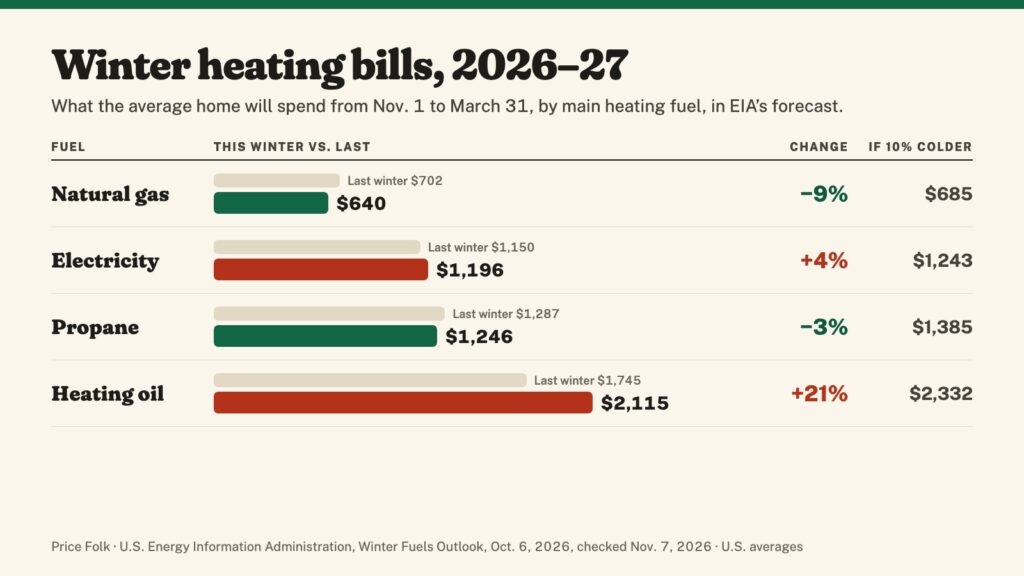
These are EIA’s forecasts for the five months from Nov. 1 to March 31, for homes grouped by the fuel they mainly heat with. Your own bill depends on your home, your thermostat and your utility’s rates, but the direction is the same for most people on the same fuel.
| Main heating fuel | Last winter | This winter | Change | If 10% colder |
|---|---|---|---|---|
| Natural gas | $702 | $640 | −9% | $685 |
| Electricity | $1,150 | $1,196 | +4% | $1,243 |
| Propane | $1,287 | $1,246 | −3% | $1,385 |
| Heating oil | $1,745 | $2,115 | +21% | $2,332 |
The “10% colder” column is EIA’s own side case: the same forecast, with 10% more heating degree days in every region. It’s the closest thing to a price tag on a hard winter.
By region
Where you live changes the picture. EIA expects a warmer winter in the Northeast than last year’s cold one, and a much colder one in the West, after an unusually warm winter there.
| Region | Natural gas | Electricity | Propane |
|---|---|---|---|
| Northeast | $879 (−14%) | $1,637 (−3%) | $1,687 (−15%) |
| Midwest | $613 (−10%) | $1,380 (+3%) | $1,305 (−4%) |
| South | $511 (−15%) | $1,079 (+3%) | $1,164 (0%) |
| West | $590 (+7%) | $1,151 (+9%) | Not forecast |
That’s why gas bills fall the most in the Northeast and South but rise in the West, and why the West has the biggest jump for electric heat, +9%. EIA doesn’t forecast propane for the West, or heating oil by region.
The regions are the Census Bureau’s. Northeast: Connecticut, Maine, Massachusetts, New Hampshire, New Jersey, New York, Pennsylvania, Rhode Island, Vermont; Midwest: Illinois, Indiana, Iowa, Kansas, Michigan, Minnesota, Missouri, Nebraska, North Dakota, Ohio, South Dakota, Wisconsin; South: Alabama, Arkansas, Delaware, District of Columbia, Florida, Georgia, Kentucky, Louisiana, Maryland, Mississippi, North Carolina, Oklahoma, South Carolina, Tennessee, Texas, Virginia, West Virginia; West: Alaska, Arizona, California, Colorado, Hawaii, Idaho, Montana, Nevada, New Mexico, Oregon, Utah, Washington, Wyoming.
Why heating oil costs so much more
EIA expects heating oil to average $5.26 a gallon this winter, up from $3.94. That’s about a third more, and it’s why the bill rises +21% even with a milder winter in the Northeast.
The reasons are global. EIA says refineries around the world are making less distillate fuel, the family heating oil belongs to, and oil flows from the Middle East remain constrained. East Coast distillate stocks fell 32% below their five-year average in September, and EIA expects them to stay about 20% below normal through the winter.
About 3% of U.S. homes heat mainly with oil, most of them in the Northeast. Natural gas heats 46% of homes, and electricity more than 40%.
What a colder winter would do
This week’s polar vortex headlines are about the chance of Arctic air spilling south later in the season. Forecasters can’t pin that down weeks ahead, so the useful question is what a colder-than-expected winter costs.
EIA’s answer, for the average home: $685 with natural gas, $1,243 with electricity, $1,385 with propane and $2,332 with heating oil, which would be +34% from last winter.
NOAA’s official winter outlook, issued Oct. 15, leans the other way for much of the country. With a very strong El Niño, it favors warmer-than-average temperatures for the Pacific Northwest, northern California, the Midwest, the Mississippi Valley and much of the East, and near-normal for parts of the Southeast. NOAA updates it on Nov. 19.
Month by month
January is the most expensive month for every fuel. Budgeting the winter evenly, the average gas-heated home needs about $128 a month, and an oil-heated home about $423.
| Month | Natural gas | Electricity | Propane | Heating oil |
|---|---|---|---|---|
| November | $111 | $213 | $201 | $360 |
| December | $140 | $253 | $274 | $465 |
| January | $146 | $270 | $302 | $509 |
| February | $128 | $230 | $251 | $420 |
| March | $116 | $230 | $218 | $361 |
U.S. averages; the calculator above shows your region. For electric heat these are whole electric bills.
 1:44
If you need help paying
The federal Low Income Home Energy Assistance Program (LIHEAP) helps with heating bills, shutoffs, reconnections and furnace repairs. On Oct. 9, HHS released $3.63 billion for this winter to states, D.C., territories and tribes, which run the program and take the applications.
To find your local office, use EnergyHelp.us or call the National Energy Assistance Referral line at 1-866-674-6327, weekdays 9 a.m. to 7 p.m. Eastern. LIHEAP never charges a fee; HHS says to report anyone who asks for one.
Behind on a utility bill? Several states bar winter shutoffs for some customers. Our cold weather rule guide has the dates state by state.
One free fix: the Energy Department estimates you can save as much as 10% on heating by setting your thermostat back 7 to 10 degrees from its normal setting.
How the calculator works
It reads EIA’s Winter Fuels Outlook tables WF01 and WF02, published Oct. 6 with the October Short-Term Energy Outlook. Your state picks one of the four Census regions, and the fuel picks the row.
If you enter last winter’s bills, we multiply them by EIA’s forecast change for your fuel and region. That keeps your home’s size and habits in the number and swaps in this winter’s prices and weather.
EIA updates the forecast every month through March. The next update is Nov. 10, and we’ll update the numbers here when it’s out.
What we don't know yet
- EIA’s Nov. 10 update. EIA revises these forecasts every month through March, and the numbers here will change with it.
- Whether the early polar vortex disruption in the news turns into extended cold in the U.S. NOAA’s next three-month outlook comes Nov. 19.
- The full LIHEAP amount for this winter. The Oct. 9 release was 90% of what the current stopgap spending law makes available; the rest depends on Congress.
- Your utility’s own rates. State regulators set gas and electric rates, and they can change during the winter.
When any of this is confirmed, it goes into the page and the update history below.
Questions people ask
How much will heating cost this winter?
It depends on your fuel. EIA expects the average home to spend $640 with natural gas, $1,196 with electricity, $1,246 with propane and $2,115 with heating oil from Nov. 1 to March 31, 2027.
Why are heating oil prices so high this winter?
Refineries worldwide are producing less distillate fuel, Middle East oil flows are still constrained and East Coast distillate stocks are about 20% below normal heading into winter, EIA says. It expects heating oil to average about $5.26 a gallon, up from $3.94 last winter.
Will a polar vortex make my heating bill higher?
Only if it brings a colder winter than forecast. In EIA’s 10%-colder case, the average home would spend $685 with gas, $1,243 with electricity, $1,385 with propane and $2,332 with heating oil. NOAA’s Oct. 15 outlook favors a warmer-than-average winter in much of the North because of El Niño.
How much is the average gas heating bill per month in winter?
About $128 a month averaged over November to March, by EIA’s forecast. January is the highest, at about $146.
Which states are in the Northeast, Midwest, South and West?
EIA uses the Census Bureau’s regions. The Northeast is New England plus New York, New Jersey and Pennsylvania. The Midwest runs from Ohio to the Dakotas, Nebraska and Kansas. The South includes Delaware, Maryland, D.C., West Virginia, Kentucky, Oklahoma and Texas. The West is the Mountain and Pacific states, plus Alaska and Hawaii.
Where can I get help paying my heating bill?
Through LIHEAP, the federal heating assistance program run by your state. Find your local office at EnergyHelp.us or call 1-866-674-6327 on weekdays. LIHEAP doesn’t charge fees, and many states also limit winter shutoffs.


