Quick answer
7-OH Ban: When the DEA’s Schedule I Order Starts, and Which Products It Covers
The DEA said its temporary ban on concentrated 7-OH could come any day from Nov. 13. Here’s the date math, the two tests that decide whether a product is covered, and what it means for kratom.

CheckedNov. 132026
The short answer
Any day now. The DEA said on Oct. 14, 2026, that its order temporarily putting concentrated 7-OH (7-hydroxymitragynine) in Schedule I “will be published in the Federal Register on or after November 13, 2026.” The ban takes effect when it’s published. It hadn’t been published as of the night of Nov. 13.
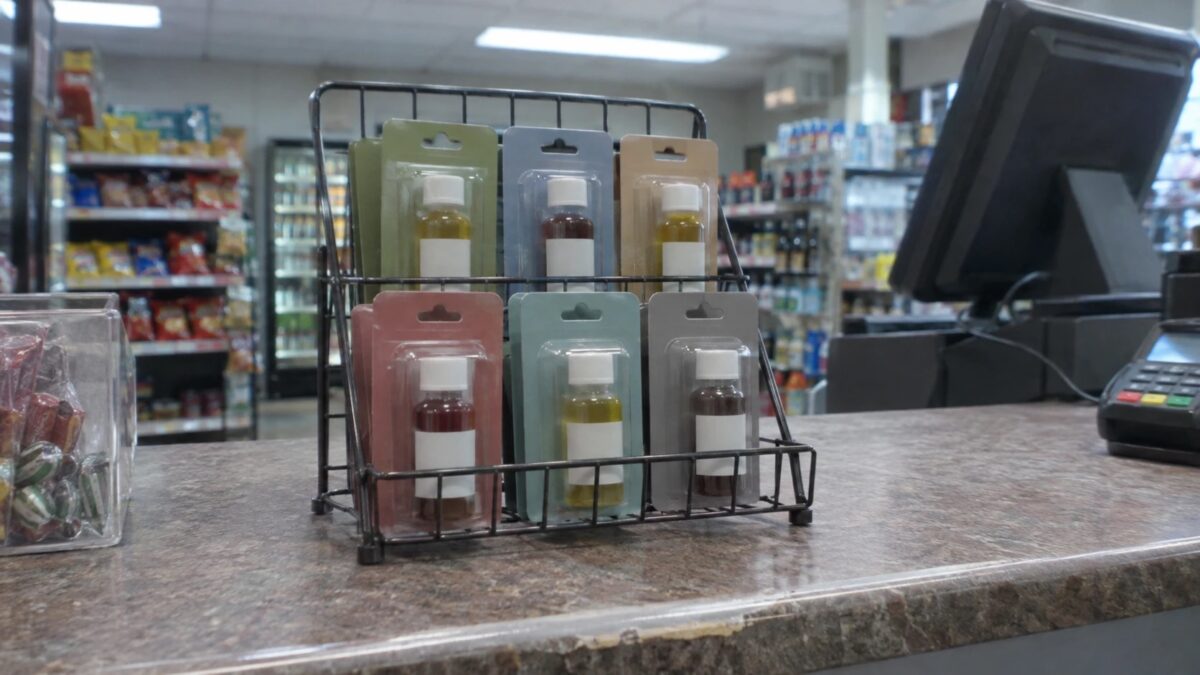
It won’t cover everything. The order applies when a product has more than 1 milligram of 7-OH per gram (or per milliliter of liquid), or when its 7-OH is high compared with the kratom plant’s main alkaloid, mitragynine. That targets the 7-OH tablets, shots and gummies, not every kratom product.
Once it’s in force, making, selling or possessing covered products is a federal crime, for at least two years while DEA works on a permanent rule.
General information, not legal advice. For your own case, ask a lawyer or the agency that enforces the rule.
At a glance
- Start
- On or after Nov. 13, 2026; effective the day DEA publishes the order in the Federal Register
- Status, Nov. 13
- Not published yet
- What
- 7-OH and mitragynine pseudoindoxyl, alone or combined, above a threshold, in Schedule I
- Threshold
- More than 1 mg per gram (solids) or per mL (liquids), or mitragynine less than 100 times the 7-OH
- How long
- Two years, with a possible one-year extension, while the permanent process runs
- Already banned
- Mitragynine pseudoindoxyl, MGM-15 and MGM-16, since Aug. 26, 2026
- Kratom leaf
- Not scheduled by this order; DEA says trace 7-OH in some kratom products is why it set a threshold
- Help
- Poison Help Line 1-800-222-1222; 911 if someone is unresponsive (FDA)
- Last checked
- Friday, Nov. 13, 2026, against the sources at the end of this page
When it starts
Federal law lets DEA put a drug in Schedule I temporarily, but only 30 days after it publishes a notice of intent. DEA published this notice on Oct. 14, 2026, so the earliest date is Nov. 13.
DEA said it intends to issue the order “as soon as possible” after that. The order takes effect when it appears in the Federal Register. We checked the Federal Register, including documents filed for public inspection, on the night of Nov. 13: nothing yet.
What the order covers
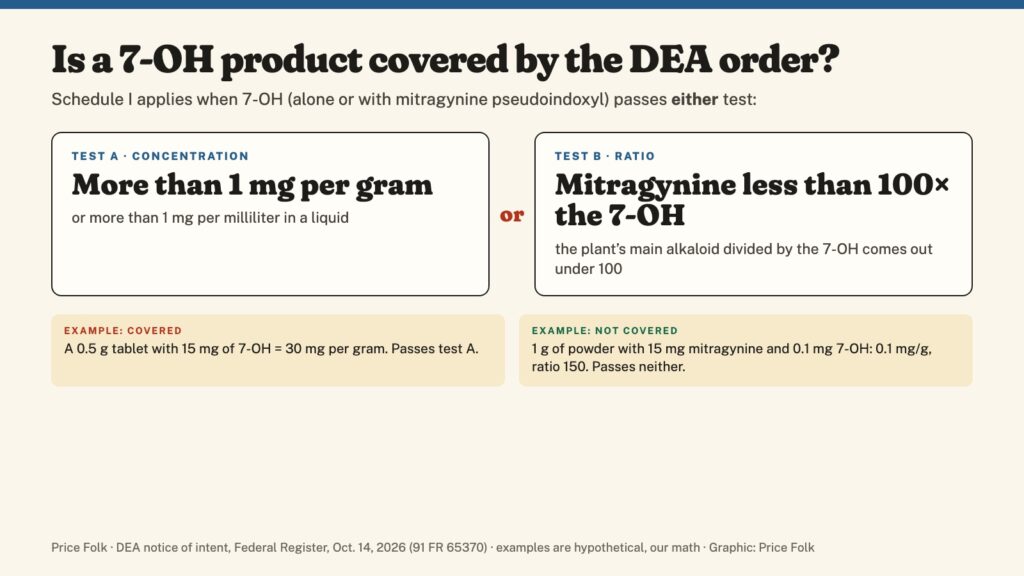
The order covers 7-OH and a related compound, mitragynine pseudoindoxyl, when either one, or both together, passes either of two tests HHS recommended on Oct. 8:
- Concentration: more than 1 mg per gram of a powder, capsule, tablet or other solid, or more than 1 mg per milliliter of a liquid.
- Ratio: the amount of mitragynine, kratom’s main alkaloid, divided by the 7-OH comes out under 100. In other words, the 7-OH is more than 1% of the mitragynine.
DEA says the threshold exists because 7-OH occurs in trace amounts in some botanical kratom products; in the plant it’s less than 2% of the alkaloids. Products made to deliver 7-OH, which the FDA describes as tablets, gummies, drink mixes and shots, are what the order is aimed at.
DEA adds a warning: it is not saying 7-OH below the threshold is safe.
What Schedule I means for you
Schedule I is the strictest category in the Controlled Substances Act. Once the order is in force, the controls and the civil and criminal penalties apply to anyone who makes, distributes, imports, exports or possesses covered products.
- Stores selling covered 7-OH products would fall under Schedule I controls the day it’s published.
- If you use 7-OH regularly, talk to a health care professional about stopping. The FDA lists withdrawal symptoms people have reported, including restlessness, body aches, fatigue, irritability and cold sweats.
- A bad reaction: call the Poison Help Line at 1-800-222-1222, or 911 if someone is unresponsive. You can also report it to the FDA’s MedWatch program online, or call 1-800-332-1088 for a form.
- State law can be stricter: some states have their own 7-OH or kratom rules. The federal order doesn’t change those.
How we got here
- July 29, 2025: FDA recommends scheduling concentrated 7-OH, tells consumers to avoid it and points to its warning letters to companies selling 7-OH tablets, gummies, drink mixes and shots.
- Dec. 2, 2025: U.S. Marshals seize about 73,000 units of 7-OH products from three Missouri firms.
- July 6, 2026: DEA’s first notice of intent, with a lower threshold. Withdrawn Oct. 14.
- Aug. 26, 2026: three related compounds (mitragynine pseudoindoxyl, MGM-15, MGM-16) go into Schedule I, temporarily, through Aug. 26, 2028.
- Oct. 8, 2026: HHS sends DEA a new threshold.
- Oct. 14, 2026: DEA’s new notice: the order “will be published in the Federal Register on or after November 13, 2026.”
- Next: the order itself. Not in the Federal Register as of the night of Nov. 13.
Poison center data in DEA’s notice shows why it moved: 165 exposure cases involving 7-OH from January through July 2025; among people exposed to 7-OH alone, 35% had serious health problems and 67% were treated at a health care facility.
How the examples work
The products in the card are made up to show the math. Concentration is milligrams of 7-OH divided by the product’s weight in grams (a 0.5 g tablet with 15 mg is 30 mg per gram). The ratio is milligrams of mitragynine divided by milligrams of 7-OH. Labels often list neither the tablet’s weight nor the mitragynine, so you may not be able to do this math from a package.
Watch
 4:57
What we don't know yet
- The exact day DEA publishes the order. It wasn’t in the Federal Register or on public inspection the night of Nov. 13.
- Whether the published order changes anything from the Oct. 14 notice.
- Which specific brands fall above or below the threshold: DEA lists no products, and labels rarely give enough to check.
- What each state does on top of the federal order.
When any of this is confirmed, it goes into the page and the update history below.
Questions people ask
When does the 7-OH ban start?
Any day from Nov. 13, 2026. DEA said its temporary Schedule I order will be published in the Federal Register on or after that date, and it takes effect on publication. It hadn’t been published as of the night of Nov. 13.
Is 7-OH illegal now?
Not federally yet, as of the night of Nov. 13, 2026. It becomes a Schedule I substance above the threshold once DEA publishes its order. The FDA already says 7-OH can’t legally be added to foods or dietary supplements, and some states ban it.
Is kratom being banned?
Not by this order. It covers 7-OH and mitragynine pseudoindoxyl above a threshold. DEA set the threshold because trace amounts of 7-OH show up in some botanical kratom products.
What is the 7-OH threshold?
More than 1 milligram per gram of a solid product or per milliliter of a liquid, or a product in which mitragynine is less than 100 times the 7-OH. Passing either test puts the product in Schedule I.
How long will the 7-OH ban last?
A temporary order lasts two years and can be extended by one more year while DEA works on permanent scheduling.
What are MGM-15 and MGM-16?
Related compounds DEA already placed in Schedule I, along with mitragynine pseudoindoxyl, on Aug. 26, 2026. That order runs until Aug. 26, 2028.