Quick answer
Vitamin K Deficiency Bleeding: Why Newborns Get the Shot, and What Skipping It Does to the Odds
More U.S. parents are declining the vitamin K shot at birth, and two studies published Nov. 5, 2026, put numbers on what happens next. Here’s what the bleeding is, the warning signs, and the risk with and without the shot.

CheckedNov. 102026
The short answer
Vitamin K deficiency bleeding (VKDB) is bleeding a baby can’t stop because their blood doesn’t have enough vitamin K to clot. It can happen anywhere in the body, including the brain, up to 6 months of age, and most of the time there are no warning signs first, the CDC says.
A single vitamin K shot after birth prevents it. Babies who don’t get the shot are 81 times more likely to develop late VKDB, according to the CDC.
It’s in the news because more parents are saying no. A study in JAMA on Nov. 5, 2026, covering 5.2 million U.S. babies, found the share who skipped the shot more than doubled, from 3.1% in 2017 to 6.8% in 2025. Those babies had 2.4 times the risk of bleeding in the brain.
General information, not medical advice. Your doctor or pharmacist can tell you what applies to you.
At a glance
- What it is
- Bleeding a baby can’t stop because of too little vitamin K; it’s often inside the body, where you can’t see it
- Who’s at risk
- Every newborn, until about 4 to 6 months, when babies start regular food
- Prevention
- One vitamin K shot in the thigh after birth; it can wait up to 6 hours so parents can bond with the baby
- Without the shot
- 81 times more likely to get late VKDB (CDC)
- How often
- Early and classical VKDB: 1 in 60 to 1 in 250 newborns; late VKDB: 1 in 14,000 to 1 in 25,000 infants (CDC)
- New U.S. data
- Babies who skipped the shot: 3.1% in 2017, 6.8% in 2025 (JAMA, Nov. 5, 2026)
- Recommended since
- 1961, by the American Academy of Pediatrics
- Last checked
- Tuesday, Nov. 10, 2026, against the sources at the end of this page
What the new studies found
Two studies came out on Nov. 5, 2026. The larger, in JAMA, was led by doctors at Children’s Hospital of Philadelphia. It used hospital records of 5,240,780 babies born from 2017 through 2025 in all 50 states.
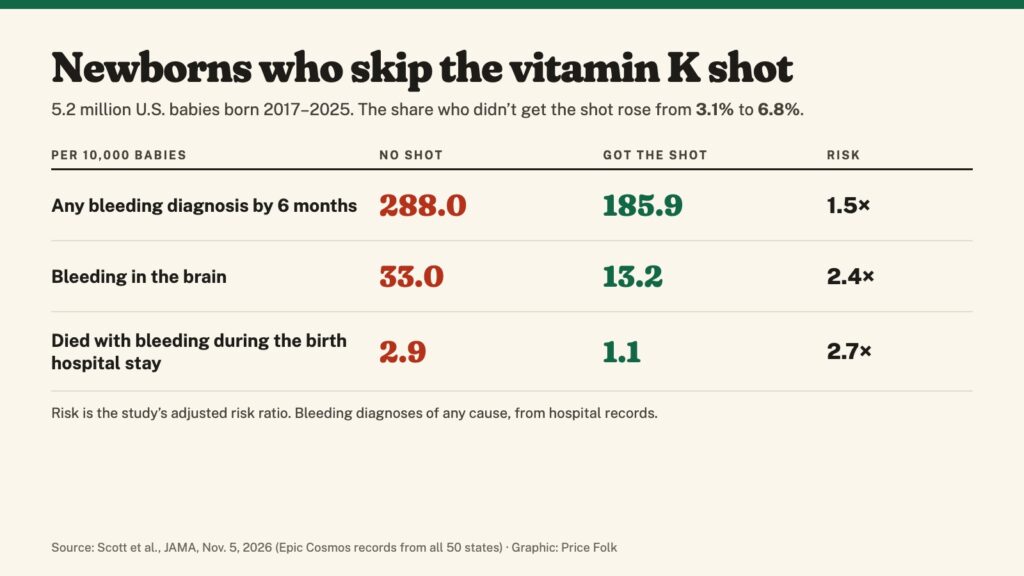
- More babies are going without it: the share who didn’t get the shot rose from 3.1% in 2017 to 6.8% in 2025.
- Any bleeding by 6 months: 288.0 per 10,000 babies without the shot, against 185.9 with it. After adjusting for other differences, that’s about 1.5 times the risk.
- Bleeding in the brain: 33.0 against 13.2 per 10,000, or 2.4 times the risk.
- Death with bleeding during the birth hospital stay: 2.9 against 1.1 per 10,000, or 2.7 times.
In plain odds (our arithmetic): bleeding in the brain was diagnosed in about 1 in 300 babies who skipped the shot, against about 1 in 760 who got it.
One caution about those numbers. The study counted bleeding diagnoses of any cause in medical records, not only bleeding from low vitamin K. It shows a link, not proof that the missing shot caused each case.
The second study, a research letter in JAMA Pediatrics from Virginia Commonwealth University, tracked diagnoses of vitamin K deficiency and the bleeding it causes over the same years. Its full text wasn’t available to us, so its numbers aren’t on this page.
The three kinds of VKDB
Doctors sort it by when it starts. The CDC’s breakdown:
| Type | When | What it looks like |
|---|---|---|
| Early | First 24 hours | Severe; mostly in babies whose mothers took certain medicines in pregnancy, such as seizure drugs or isoniazid |
| Classical | Day 2 to 1 week | Bruising, bleeding from the umbilical cord |
| Late | 1 week to 6 months, most often at 2 to 8 weeks | Bleeding in the brain in 30% to 60% of cases; mostly in breastfed-only babies who didn’t get the shot; warning bleeds are rare |
Late VKDB is the one that worries doctors most. It strikes babies who seem perfectly healthy, weeks after they’ve gone home.
Why babies need it
Newborns start life with very little vitamin K. Not much crosses the placenta, the gut bacteria that make it aren’t there yet, and breast milk has only small amounts.
The CDC says eating more vitamin K or taking supplements raises the level in breast milk only slightly, not enough to cover what a baby needs. Babies stay at risk until they start regular food, usually around 4 to 6 months.
The shot works twice: part goes into the blood right away, and the rest is released slowly over the next 2 to 3 months.
Warning signs
Most babies with VKDB show no warning signs before a life-threatening bleed, the CDC says. When there are signs, these are the ones it lists:
- Bruises, especially around the head and face
- Bleeding from the nose or umbilical cord
- Paler skin than before; in babies with darker skin, pale gums
- Yellow whites of the eyes after the first 3 weeks
- Blood in the stool, black and sticky stool, or vomiting blood
- Irritability, seizures, too much sleepiness or a lot of vomiting, possible signs of bleeding in the brain
Any of these is a reason to call your baby’s doctor right away.
Is the shot safe?
The CDC says yes. The risks are those of any shot: pain, bruising or swelling where it goes in. A few cases of skin scarring have been reported, and one allergic reaction in an infant, ever.
The cancer worry traces to a small 1990 study in England. Larger studies since then found no link between the shot and childhood cancer.
The shot contains a small amount of a common preservative, benzyl alcohol. The CDC says the amount isn’t enough to be dangerous.
To make it easier on your baby, you can ask to hold the baby during the shot, and breastfeeding during or right after it helps, the CDC says.
 4:25
What we don't know yet
- The numbers in the companion JAMA Pediatrics letter by Wolf and colleagues. News reports cite a 347% rise in vitamin K–deficient bleeding diagnoses from 2017 to 2025; the full text wasn’t available to us to check.
- Why more parents are declining the shot. Neither study asked them.
- How much of the extra bleeding in the JAMA study came from low vitamin K. It counted bleeding of any cause.
When any of this is confirmed, it goes into the page and the update history below.
Questions people ask
What is vitamin K deficiency bleeding?
Bleeding in a baby who doesn’t have enough vitamin K for their blood to clot. It can happen inside or outside the body, often in the intestines or the brain, at any time up to 6 months of age in babies who didn’t get the vitamin K shot at birth.
Why do newborns get a vitamin K shot?
Babies are born with very little vitamin K, and breast milk has only small amounts, so they can’t clot well for months. One shot after birth prevents vitamin K deficiency bleeding. The American Academy of Pediatrics has recommended it since 1961.
What happens if a baby doesn’t get the vitamin K shot?
The CDC says babies who don’t get it are 81 times more likely to develop late vitamin K deficiency bleeding. In a JAMA study of 5.2 million U.S. babies published Nov. 5, 2026, those who didn’t get the shot had 2.4 times the risk of bleeding in the brain.
How common is vitamin K deficiency bleeding?
The CDC puts early and classical VKDB at 1 in 60 to 1 in 250 newborns and late VKDB at 1 in 14,000 to 1 in 25,000 infants. It’s rare in the U.S. because most newborns get the shot.
What are the signs of vitamin K deficiency bleeding?
Often there are none before a serious bleed. The CDC lists bruises around the head and face, bleeding from the nose or umbilical cord, paler skin or pale gums, yellow eyes after 3 weeks, blood in the stool or black sticky stool, vomiting blood, and irritability, seizures, too much sleepiness or a lot of vomiting.
How many parents refuse the vitamin K shot?
In the JAMA study published Nov. 5, 2026, 6.8% of U.S. newborns born in 2025 didn’t get the shot, up from 3.1% in 2017.
Is the vitamin K shot safe?
Yes, according to the CDC. Its risks are those of any shot, such as pain, bruising or swelling. A few cases of skin scarring and a single allergic reaction in an infant have been reported.
Does the vitamin K shot cause cancer?
No. A small 1990 study in England suggested a link, but larger studies since then found no evidence that the shot causes childhood cancer, the CDC says.
Can the vitamin K shot be delayed after birth?
Yes, for a few hours. The CDC says it can be delayed up to 6 hours after birth so parents and baby can bond first.