Calculator
401(k) Limits for 2027: $25,500, the Catch-Up for Your Age, and What to Set Per Paycheck
Pick your birth year and pay schedule to see your 2027 limit and the amount per paycheck that reaches it.

CheckedNov. 122026
Calculator
Your 2027 401(k) limit, per paycheck
Pick your birth year and how often you’re paid. We apply the IRS limits for 2027 and 2026 and show what it takes per paycheck to reach yours.
This calculator needs JavaScript. Everything it uses is also in the text below.
Runs in your browser. Nothing you enter is sent or saved.
The short answer
The 2027 limit for 401(k) plans is $25,500, up $1,000 from 2026. The IRS announced it on Nov. 12, 2026. The same limit covers 403(b) plans, governmental 457 plans and the federal Thrift Savings Plan.
If you’re 50 or older by the end of 2027, you can add $8,500 more, for $34,000. If you turn 60, 61, 62 or 63 in 2027, the catch-up is $11,750, for $37,250.
The IRA limit stays at $7,500, or $8,600 at 50 and older. On a biweekly paycheck, maxing out a 401(k) in 2027 takes $980.77 per paycheck under 50.
At a glance
- Announced
- Nov. 12, 2026, in IRS Notice 2026-66
- 401(k), 403(b), 457, TSP
- $25,500 (was $24,500 in 2026)
- Catch-up at 50+
- $8,500 more, $34,000 total (was $8,000 and $32,500)
- Catch-up at 60 to 63
- $11,750 more, $37,250 total (was $11,250 and $35,750)
- IRA
- $7,500; $8,600 at 50+ (unchanged)
- Roth catch-up rule
- Catch-ups must be Roth if your 2026 wages from that employer topped $155,000
- Employer + you, total
- $75,000 (was $72,000)
- SIMPLE IRA
- $17,500 (was $17,000); catch-up $4,000
- Last checked
- Thursday, Nov. 12, 2026, against the sources at the end of this page
The 2027 limits, by age
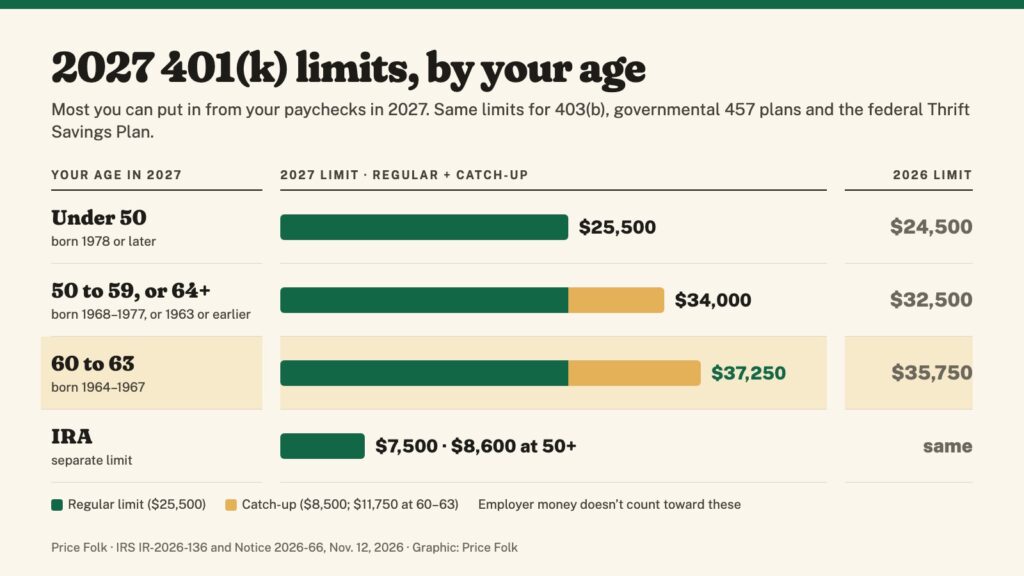
These are the most you can put in from your own paychecks in 2027. They’re the same for a 401(k), a 403(b), a governmental 457 plan and the Thrift Savings Plan.
Catch-ups go by the age you reach by Dec. 31. You don’t have to wait for your birthday: if you turn 50 in December 2027, the catch-up applies all year.
| Your age in 2027 | Born | 2027 limit | 2026 limit | Change |
|---|---|---|---|---|
| Under 50 | 1978 or later | $25,500 | $24,500 | +$1,000 |
| 50 to 59 | 1968 to 1977 | $34,000 ($25,500 + $8,500) | $32,500 | +$1,500 |
| 60 to 63 | 1964 to 1967 | $37,250 ($25,500 + $11,750) | $35,750 | +$1,500 |
| 64 and older | 1963 or earlier | $34,000 ($25,500 + $8,500) | $32,500 | +$1,500 |
The highlighted row is the biggest limit anyone gets. It only lasts four years: the year you turn 64, you drop back to the regular catch-up.
So someone born in 1963 can put in $35,750 in 2026, at 63, and $34,000 in 2027, at 64. That’s the one case where the limit goes down.
What it takes per paycheck
Spread evenly over a full year of paychecks, here’s what maxing out looks like. Payroll systems round, so your stub may be off by a few cents.
| 2027 limit | Every week (52) | Every two weeks (26) | Twice a month (24) | Monthly (12) |
|---|---|---|---|---|
| $25,500 (under 50) | $490.38 | $980.77 | $1,062.50 | $2,125.00 |
| $34,000 (50 to 59, 64+) | $653.85 | $1,307.69 | $1,416.67 | $2,833.33 |
| $37,250 (60 to 63) | $716.35 | $1,432.69 | $1,552.08 | $3,104.17 |
If you maxed out in 2026 on a biweekly schedule, keeping pace in 2027 means about $38.46 more per paycheck under 50, or $57.69 more with a catch-up.
Many plans don’t take a dollar amount, only a whole percentage. Round up and you’ll hit the limit a paycheck or two before December. Check whether your plan stops you at the limit or keeps deducting; HR or the plan’s website can tell you.
If your employer matches
The match doesn’t count toward $25,500. The ceiling for everything going into your account, yours and your employer’s together, is $75,000 in 2027, up from $72,000.
One thing to ask HR: some plans match each paycheck, so if you hit the limit early, you could miss the match on the last few. Others “true up” at the end of the year. Spreading it evenly avoids the question.
The Roth catch-up rule starts for most plans in 2027
If you’re 50 or older and earned more than $155,000 in Social Security wages from your employer in 2026 (box 3 of your W-2), your 2027 catch-up has to go in as a Roth contribution. You pay tax on it now, and it comes out tax-free later.
The regular $25,500 can still be pretax. Only the catch-up part changes.
The IRS’s final regulations on this rule generally apply to contributions starting in 2027; some plans started in 2026. A few government and union plans get more time. Plans don’t have to offer catch-ups at all, so if yours has no Roth option, ask whether you can still make one.
IRA limits for 2027
The IRA limit stays at $7,500, with the $1,100 catch-up at 50 and older. That’s $625 a month, or $716.67 with the catch-up.
It’s a separate limit from your 401(k), so you can fill both. What changes are the income lines that decide whether you can deduct a traditional IRA or put money into a Roth IRA.
| Who | 2027 income range | 2026 income range |
|---|---|---|
| Roth IRA, single or head of household | $158,000 to $173,000 | $153,000 to $168,000 |
| Roth IRA, married filing jointly | $250,000 to $260,000 | $242,000 to $252,000 |
| Traditional IRA deduction, single, covered by a work plan | $83,000 to $93,000 | $81,000 to $91,000 |
| Traditional IRA deduction, married jointly, you’re covered by a work plan | $133,000 to $153,000 | $129,000 to $149,000 |
| Traditional IRA deduction, you’re not covered but your spouse is | $250,000 to $260,000 | $242,000 to $252,000 |
| Married filing separately, covered by a work plan (both rules) | $0 to $10,000 | $0 to $10,000 |
Below the range, you get the full amount. Inside it, the amount shrinks. Above it, you can’t deduct a traditional IRA or contribute to a Roth IRA directly. If neither you nor your spouse has a retirement plan at work, the deduction has no income limit.
The IRA deadline is your tax filing date, not Dec. 31. You can put in money for 2026 until April 15, 2027.
Other 2027 numbers in the IRS notice
- SIMPLE IRA and SIMPLE 401(k): $17,500 (from $17,000); $19,100 at some small employers. Catch-up stays $4,000, or $5,250 at 60 to 63.
- Highly compensated employee: $170,000 (from $160,000). It decides who can be limited by your plan’s testing.
- Pay counted for contributions: up to $375,000 (from $360,000).
- Qualified charitable distributions from an IRA at 70½ and older: up to $114,000 (from $111,000).
- Saver’s Credit: starting in 2027, a new Saver’s Match replaces it for 401(k) and IRA contributions, according to the notice. The credit stays only for ABLE accounts, with income limits of $83,000 joint, $62,250 head of household and $41,500 single.
How we figured the per-paycheck amounts
Each limit comes straight from IRS Notice 2026-66 and the IRS announcement of Nov. 12, 2026; the 2026 limits from the IRS’s 2026 announcement. We divided each limit by 52, 26, 24 and 12 and rounded to the cent. Birth years assume the age you reach by Dec. 31, the rule on the IRS catch-up page.
What we don't know yet
- Details of the new Saver’s Match that replaces the Saver’s Credit for 2027 contributions (how much, who qualifies, when it’s paid). The IRS notice points to separate guidance, Notice 2026-48, which we haven’t reviewed for this page.
- Whether your own plan offers catch-ups, a Roth option and an end-of-year match true-up. Those are plan choices, not IRS rules: check your plan’s summary or ask HR.
- The 2027 limits for health savings accounts (HSAs). The IRS sets them in a separate announcement, not in this notice.
When any of this is confirmed, it goes into the page and the update history below.
Questions people ask
What is the 401(k) limit for 2027?
$25,500, up from $24,500 in 2026. It covers what you put in from your paychecks to a 401(k), 403(b), governmental 457 plan or the Thrift Savings Plan.
What is the 401(k) catch-up limit for 2027?
$8,500 for people 50 and older, so $34,000 in total. If you turn 60, 61, 62 or 63 in 2027, the catch-up is $11,750, so $37,250 in total.
What is the 401(k) limit for 2027 if I’m over 50?
$34,000: the $25,500 regular limit plus the $8,500 catch-up. Between 60 and 63 it’s $37,250.
What is the 401(k) limit for 2027 if I’m over 65?
$34,000. The higher catch-up only applies in the years you turn 60 through 63; from 64 on, it’s the regular $8,500 catch-up.
What is the IRA limit for 2027?
$7,500, the same as 2026, plus a $1,100 catch-up at 50 and older for $8,600. It applies to traditional and Roth IRAs combined.
How much should I contribute per paycheck to max out my 401(k) in 2027?
Under 50: $980.77 every two weeks, $1,062.50 twice a month or $490.38 a week. At 50 and older: $1,307.69 every two weeks. At 60 to 63: $1,432.69 every two weeks.
Does my employer match count toward the 401(k) limit?
No. The $25,500 is only what you put in. Your employer’s match goes on top, up to $75,000 in total for 2027.
Do my catch-up contributions have to be Roth?
Only if your Social Security wages from that employer were over $155,000 in 2026. Then your 2027 catch-up must be Roth; the regular $25,500 can still be pretax.
Can I contribute to both a 401(k) and an IRA?
Yes. They have separate limits. Whether you can deduct a traditional IRA, or contribute to a Roth IRA, depends on your income; the ranges are in the table above.