Calculator
2027 Tax Brackets and Tax Calculator: The IRS Numbers, and What You’ll Owe
Type your income to see your 2026 or 2027 federal income tax, bracket by bracket, under the IRS’s new tables.

CheckedNov. 72026
Calculator
Federal income tax calculator, 2026 and 2027
Enter your income and filing status. We run it through the IRS brackets and show the tax bracket by bracket, next to the other year.
This calculator needs JavaScript. Everything it uses is also in the text below.
Runs in your browser. Nothing you enter is sent or saved.
The short answer
The IRS released the 2027 tax brackets on Nov. 5, 2026. The seven rates stay the same, from 10% to 37%, and every bracket starts about 3.2% higher than in 2026.
The 2027 standard deduction is $16,600 for single filers, $33,200 for married couples filing jointly and $24,925 for heads of household.
These numbers apply to money you earn in 2027 and the return you file in 2028. The return you file in early 2027 uses the 2026 table, which is also below.
At a glance
- Announced
- Nov. 5, 2026, in IRS Revenue Procedure 2026-35
- Applies to
- Income earned in 2027; the tax return you file in 2028
- Tax rates
- Unchanged: 10%, 12%, 22%, 24%, 32%, 35%, 37%
- Brackets
- Each starts about 3.2% higher than in 2026
- Standard deduction
- $16,600 single · $33,200 married filing jointly · $24,925 head of household
- Top rate starts
- Over $661,375 single, $793,650 married filing jointly
- Child tax credit
- Up to $2,300 per child; up to $1,800 refundable
- Filing in early 2027?
- Use the 2026 table: standard deduction $16,100 single, $32,200 joint, $24,150 head of household
- Last checked
- Saturday, Nov. 7, 2026, against the sources at the end of this page

The 2027 federal income tax brackets
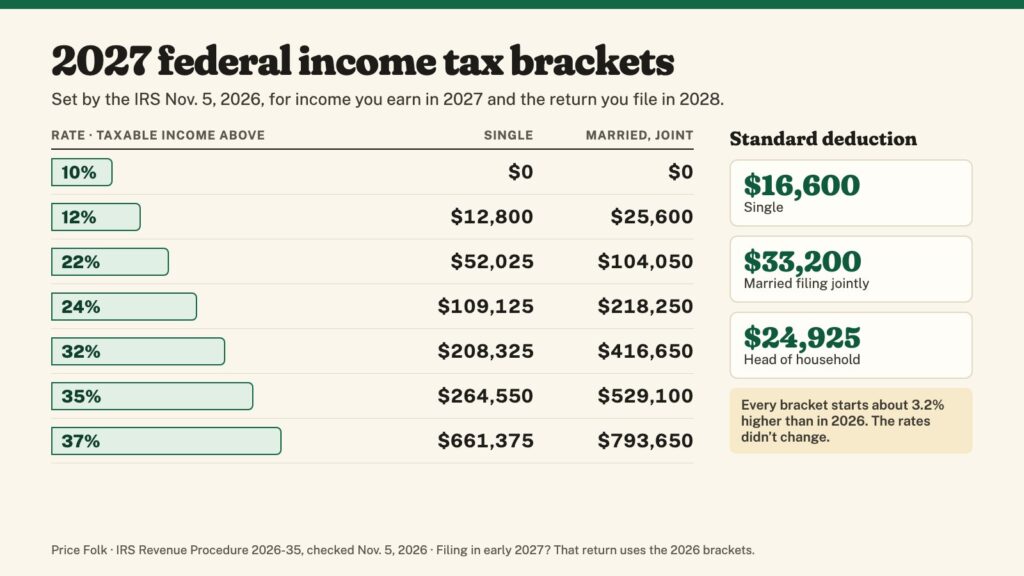
These are the IRS’s rate tables for tax year 2027, from Revenue Procedure 2026-35. They apply to taxable income, which is your income after the standard deduction or your itemized deductions.
Each rate covers only the slice of income inside its row. Moving into the 22% bracket doesn’t raise the tax on the dollars below it.
| Rate | Single | Married filing jointly | Head of household | Married filing separately |
|---|---|---|---|---|
| 10% | $0 to $12,800 | $0 to $25,600 | $0 to $18,250 | $0 to $12,800 |
| 12% | $12,801 to $52,025 | $25,601 to $104,050 | $18,251 to $69,650 | $12,801 to $52,025 |
| 22% | $52,026 to $109,125 | $104,051 to $218,250 | $69,651 to $109,100 | $52,026 to $109,125 |
| 24% | $109,126 to $208,325 | $218,251 to $416,650 | $109,101 to $208,300 | $109,126 to $208,325 |
| 32% | $208,326 to $264,550 | $416,651 to $529,100 | $208,301 to $264,550 | $208,326 to $264,550 |
| 35% | $264,551 to $661,375 | $529,101 to $793,650 | $264,551 to $661,350 | $264,551 to $396,825 |
| 37% | Over $661,375 | Over $793,650 | Over $661,350 | Over $396,825 |
Surviving spouses use the married-filing-jointly column. The top rate starts at $661,375 for single filers and $793,650 for married couples filing jointly.
Which table goes with which tax return
This is where most of the confusion comes from. The number in “2027 tax brackets” is the year you earn the money, not the year you file.
- The return you file in early 2027 covers 2026 income, so it uses the 2026 table below.
- The 2027 table covers money you earn from Jan. 1, 2027, and the return you file in 2028.
2026 brackets, for the return you file in 2027
| Rate | Single | Married filing jointly | Head of household | Married filing separately |
|---|---|---|---|---|
| 10% | $0 to $12,400 | $0 to $24,800 | $0 to $17,700 | $0 to $12,400 |
| 12% | $12,401 to $50,400 | $24,801 to $100,800 | $17,701 to $67,450 | $12,401 to $50,400 |
| 22% | $50,401 to $105,700 | $100,801 to $211,400 | $67,451 to $105,700 | $50,401 to $105,700 |
| 24% | $105,701 to $201,775 | $211,401 to $403,550 | $105,701 to $201,750 | $105,701 to $201,775 |
| 32% | $201,776 to $256,225 | $403,551 to $512,450 | $201,751 to $256,200 | $201,776 to $256,225 |
| 35% | $256,226 to $640,600 | $512,451 to $768,700 | $256,201 to $640,600 | $256,226 to $384,350 |
| 37% | Over $640,600 | Over $768,700 | Over $640,600 | Over $384,350 |
Every threshold moved up about 3.2% from 2026 to 2027. The seven rates themselves didn’t change.
2027 standard deduction
Most people take the standard deduction instead of itemizing. For 2027 it goes up $500 for single filers, $1,000 for married couples filing jointly and $775 for heads of household.
| Filing status | 2025 | 2026 | 2027 |
|---|---|---|---|
| Single | $15,750 | $16,100 | $16,600 |
| Married filing jointly | $31,500 | $32,200 | $33,200 |
| Head of household | $23,625 | $24,150 | $24,925 |
| Married filing separately | $15,750 | $16,100 | $16,600 |
If you’re 65 or older or blind, you add $1,700 per person in 2027, or $2,100 if you’re unmarried and not a surviving spouse. In 2026 those were $1,650 and $2,050.
The senior deduction from the 2025 tax law is separate and doesn’t change with inflation: up to $6,000 per person 65 or older, or $12,000 for a couple who both qualify, from 2025 through 2028. You get it whether or not you itemize, and married people have to file jointly to claim it.
It shrinks by 6 cents for every dollar of modified adjusted gross income over $75,000, or $150,000 for joint filers, so it’s gone at $175,000 single and $250,000 joint. That’s the math on Schedule 1-A, and the calculator above does it for you.
Same pay, a little less tax
Here’s what the new numbers do if your income doesn’t change from 2026 to 2027. Wider brackets and a bigger standard deduction mean a few more dollars taxed at the lowest rates.
| Filer and income | Tax in 2026 | Tax in 2027 | You owe |
|---|---|---|---|
| Single, $40,000 | $2,620 | $2,552 | $68 less |
| Single, $85,000 | $9,870 | $9,590 | $280 less |
| Single, $200,000 | $36,734 | $36,375 | $359 less |
| Head of household, $55,000 | $3,348 | $3,244 | $104 less |
| Married filing jointly, $80,000 | $5,240 | $5,104 | $136 less |
| Married filing jointly, $175,000 | $20,840 | $20,279 | $561 less |
| Married filing jointly, $300,000 | $49,468 | $48,750 | $718 less |
Federal income tax only, on wages, with the standard deduction and no credits. Rounded to the dollar.
The savings are small on purpose. The adjustment exists so that a raise that only keeps up with prices doesn’t push more of your pay into a higher bracket.
Other 2027 numbers in the same IRS release
- Child tax credit: up to $2,300 per child, $100 more than 2026; up to $1,800 of it is refundable. Our child tax credit calculator runs your family’s numbers for 2026 and 2027.
- Earned income tax credit: up to $8,496 with three or more qualifying children, $7,552 with two, $4,573 with one and $685 with none.
- Long-term capital gains: the 0% rate applies up to $51,050 of taxable income for single filers and $102,100 for joint filers; 15% up to $563,200 and $633,600.
- Gift tax annual exclusion: $20,000 per person you give to, up from $19,000.
- Estate tax exclusion: $15,480,000 for people who die in 2027.
- Health FSA: up to $3,500 in salary contributions; $700 can carry over where the plan allows it.
- Transit and parking benefits: $350 a month each, tax-free.
- Adoption credit: up to $18,250, with up to $5,280 refundable.
The tips, overtime and car-loan interest deductions work the same way in 2027: up to $25,000 of qualified tips, $12,500 of qualified overtime pay ($25,000 joint) and $10,000 of interest on a loan for a qualifying new vehicle. Those caps are set in the 2025 law rather than the inflation tables, and like the senior deduction they run through 2028.
The 2027 401(k) and IRA limits came out separately, on Nov. 12: $25,500 for a 401(k) and $7,500 for an IRA. Our 401(k) limit calculator shows the catch-up for your age and what it takes per paycheck.
How we figured the tax
We took each example income, subtracted that year’s standard deduction and ran the result through the IRS rate tables for 2026 and 2027, then rounded to the dollar.
The calculator does the same with your numbers. It adds the extra standard deduction for 65 or older or blind, and the senior deduction with its 6% phase-out, from IRS Schedule 1-A. It stops before credits, so the child tax credit and others come off the number it shows.
It uses the IRS rate schedules. Below $100,000 of taxable income the IRS tax table works in $50 steps, so your return can differ from the calculator by a few dollars.
The 3.2% is our comparison of the 2027 thresholds with the 2026 ones in the two revenue procedures. Your own return will differ with other income, credits and deductions.
Watch
 1:29
What we don't know yet
- The 2027 withholding tables employers use for paychecks, and the final 2027 Form W-4.
- Whether Congress extends the senior, tips, overtime and car-loan deductions past 2028. Under current law they end after tax year 2028.
When any of this is confirmed, it goes into the page and the update history below.
Questions people ask
What are the tax brackets for 2027?
For single filers: 10% up to $12,800 of taxable income, 12% up to $52,025, 22% up to $109,125, 24% up to $208,325, 32% up to $264,550, 35% up to $661,375 and 37% above that. For married couples filing jointly the thresholds are $25,600, $104,050, $218,250, $416,650, $529,100 and $793,650.
How do I calculate my 2027 federal income tax?
Subtract your deduction from your income: $16,600 for single filers, $33,200 for married couples filing jointly or $24,925 for heads of household, unless you itemize. Then tax each slice of what’s left at its bracket’s rate. The calculator at the top of this page does it for 2026 and 2027.
What is the standard deduction for 2027?
$16,600 for single filers and married people filing separately, $33,200 for married couples filing jointly and $24,925 for heads of household. People 65 or older or blind add $1,700 each, or $2,100 if unmarried.
Do the 2027 tax brackets apply to the taxes I file in 2027?
No. The return you file in early 2027 is for 2026 income and uses the 2026 brackets, with a standard deduction of $16,100 single, $32,200 joint and $24,150 head of household. The 2027 brackets apply to the return you file in 2028.
Did tax rates go up for 2027?
No. The seven rates are the same as in 2026, from 10% to 37%. What changed are the income levels where each rate starts, about 3.2% higher.
How much will I save with the 2027 tax brackets?
If your income stays the same, not much: in our examples, $68 for a single filer earning $40,000, $280 at $85,000 and $718 for a married couple at $300,000. If your pay rises with inflation, your tax rises roughly in step.
What is the standard deduction for seniors in 2027?
A single filer 65 or older gets $16,600 plus $2,100, or $18,700. A married couple filing jointly who are both 65 or older gets $33,200 plus $1,700 each, or $36,600. On top of that, the senior deduction allows up to $6,000 per person through 2028; it shrinks by 6% of modified AGI over $75,000 ($150,000 joint) and is gone at $175,000 ($250,000 joint).
What is the child tax credit for 2027?
Up to $2,300 per qualifying child, $100 more than in 2026. Up to $1,800 of it is refundable.
What are the 2027 401(k) and IRA limits?
The IRS announced them on Nov. 12, 2026: $25,500 for a 401(k), 403(b), governmental 457 plan or the Thrift Savings Plan, plus an $8,500 catch-up at 50 and older ($11,750 at ages 60 to 63). The IRA limit stays $7,500, with a $1,100 catch-up.


